PANTA Whitepaper: The AI Label Isn’t the Problem. Bad Journalism Is.
A PANTA study with 360 participants shows that labeling AI-generated articles does not automatically reduce acceptance. What matters most is interest, quality, context, and trust.

A PANTA study with 360 participants shows that labeling AI-generated articles does not automatically reduce acceptance. What matters most is interest, quality, context, and trust.
Publishers currently face an uncomfortable choice. They can use AI in the newsroom and worry about losing their audience’s trust. Or they can downplay its use—and risk a lack of transparency, regulatory problems, and a growing shadow AI infrastructure.
This choice is often driven by the same assumption: as soon as readers see an “AI-generated” label, they will be less willing to continue reading. That is exactly the assumption we tested. The result is far less dramatic—and much more useful in practice.
The label itself is not the primary factor determining acceptance. What matters is whether an article is relevant, understandable, credible, trustworthy, and well produced. Transparency remains important. But it cannot replace editorial quality.
In Short
Within the same topic context, the AI label had no significant main effect on readers’ intention to continue reading.
The topic itself shaped evaluations more strongly than the stated authorship.
Interest was the strongest—and only consistently significant—driver across all articles tested.
Since August 2, 2026, Article 50 of the EU AI Act has made transparency an operational requirement in certain cases, including technical marking and human-facing disclosure.
What We Actually Tested
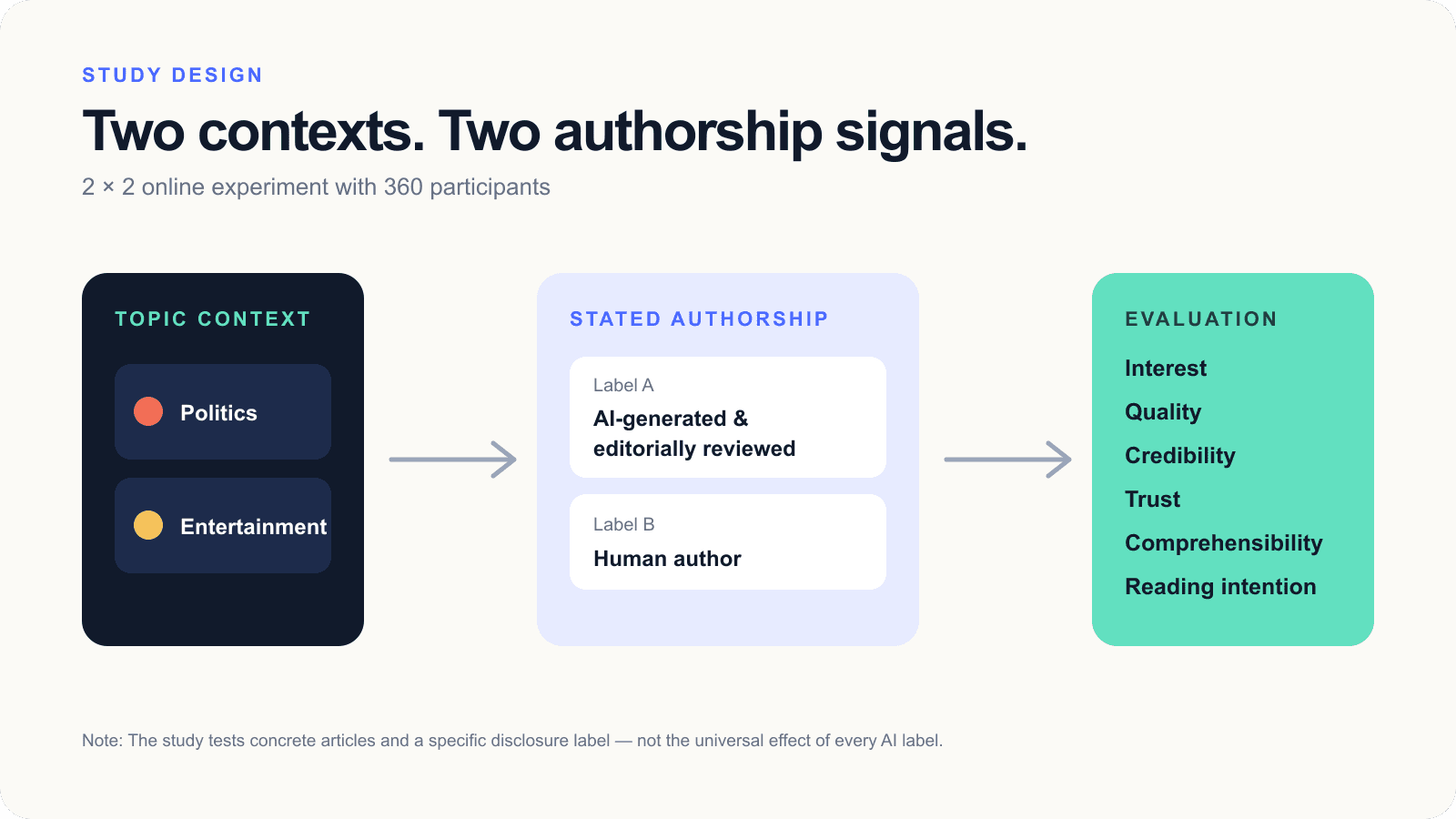
The study used a 2×2 online experiment. A total of 360 participants read journalistic articles in either a political or an entertainment context. At the same time, the stated authorship varied: one version was labeled “AI-generated & editorially reviewed,” while the other named a human author.
Participants then evaluated the articles based on interest, quality, credibility, trustworthiness, comprehensibility, and their intention to continue reading.
The study was therefore not about the abstract question of whether people like AI. It examined a specific use case: what happens when a realistically presented editorial article visibly involves AI?
The Label Is Not an Acceptance Killer
The central finding is clear: within the same topic context, the AI label had no significant main effect on readers’ intention to continue reading. An article was not rejected simply because its use of AI was transparently disclosed.
This is not a blank check for every form of automated content. The study tested a specific, clearly worded label that explicitly included editorial review. The results do not prove that every label, topic, or publication will produce the same response. They do show that the common equation “AI label = loss of trust” is too simplistic.
For editorial teams, this changes the question. It is no longer: How do we hide the use of AI? It becomes: How do we make quality, responsibility, and editorial control visible?
Content Beats the Label
The topic context influenced evaluations more strongly than authorship. Political and societal content was assessed more sensitively than entertainment. This is consistent with participants’ explicit perceptions: 73.6 percent identified politics and social policy as a particularly critical area for AI-generated journalism. For culture and entertainment, the figure was 24.2 percent.
Transparency should therefore not be implemented as the same generic notice across every type of content. A stock-market analysis, an election forecast, and a festival guide involve very different risks. Good governance begins by recognizing those differences.

Interest Is the Strongest Driver
The overall model explained around 68 percent of the variation in readers’ intention to continue reading. Interest was the strongest factor, followed by perceived quality, trustworthiness, and credibility. When the other factors were considered at the same time, comprehensibility made almost no additional contribution.
That is good news for content teams. Readers do not respond only to signals about where content came from. They respond to the value an article provides. AI can accelerate research, structuring, and production. Acceptance, however, only emerges when that process results in relevant content.

Audiences Are Less Demographic Than Many Assume
Age, gender, and other demographic characteristics did not emerge as dominant, consistent moderators. This challenges broad assumptions such as “younger people will accept AI anyway” or “older people will reject it by default.”
A behavior-based segmentation is more useful. How interested is the person in the topic? How familiar are they with AI? How sensitive is the context? And what form of editorial responsibility is visible?
What the EU AI Act Has Changed Since August 2026
Article 50 of the EU AI Act has applied since August 2, 2026. Providers of generative AI systems must generally ensure that synthetic outputs are marked in a machine-readable format. Those publishing certain AI-generated or manipulated content must also disclose it to people—for example, deepfakes or text intended to inform the public on matters of public interest.
An important exception is provided for editorial content: the additional disclosure requirement does not apply where the content has undergone human review or editorial control and a natural or legal person holds editorial responsibility. The precise classification depends on the specific use case and should not replace legal advice.
In practice, two layers now come together: technical provenance and understandable communication with the audience. A visible label alone is not a compliance system. And a compliance system alone does not create trust.
What Publishers Should Do Now
First, classify content by risk and context. Politics, health, and finance require different approval processes than entertainment or service content.
Second, make editorial control verifiable. Who reviewed the article? Which sources were used? What changes were made? Responsibility should not merely exist—it should be traceable throughout the process.
Third, use labels that people can understand. “AI-generated & editorially reviewed” communicates something very different from a technically correct but meaningless symbol.
Fourth, measure acceptance—not just clicks. Interest, perceived quality, trust, and abandonment rates indicate whether an AI-supported workflow is working for the audience.
Fifth, learn from every use case. Templates, approvals, and models should improve based on real outcomes rather than intuition.

What We Learned
Transparency and acceptance are not opposites. The label is rarely the strongest factor—and that is precisely why it should not be considered in isolation. Anyone using AI responsibly in content production needs relevant content, clear editorial accountability, and a traceable workflow.
The better question is therefore not: Do people accept AI-generated articles? It is: Under what conditions do AI-supported articles deserve their attention and trust?
That is where PANTA comes in: treating AI use not as an isolated tool, but as a controllable process with roles, approvals, documentation, and measurement points.
Article written by
