AI enters companies quietly.
It usually begins with individual use in daily tasks. Over time it spreads across teams and gradually changes how work is organized and performed.

It usually begins informally. An employee experiments with ChatGPT. Marketing tests image generation. A team automates a small repetitive task.
The barrier to entry is low and the results are immediate. Because of that, AI spreads inside organizations faster than any previous software category.
After a few months, a new situation appears. AI exists everywhere, but nowhere in a structured way.
Different tools are used in parallel.
Costs emerge in many places.
Data leaves the organization unintentionally. Some employees rely on AI daily, others not at all.
Outputs vary in quality and are difficult to evaluate.
At this point many organizations realize:
The problem is not adopting AI.
The problem is operating AI.
AI changes how work happens
Traditional software supports workflows. AI now actively contributes to decisions, writing and analysis across everyday work.
Responsibility shifts to usage
Automations are built by non-developers and used daily. Outcomes depend on how people interact with AI.
New questions appear
Who may use AI, what data is allowed and who reviews results. These are organizational questions, not tool questions.

When AI moves beyond experimentation







Most organizations eventually reach the same point. AI is used in everyday work but it does not belong to the organization yet. Decisions, content and workflows depend on individuals rather than shared structures.
At this stage experimentation is no longer enough. AI has to become part of how the organization operates, with shared access, defined processes and reviewable outcomes.
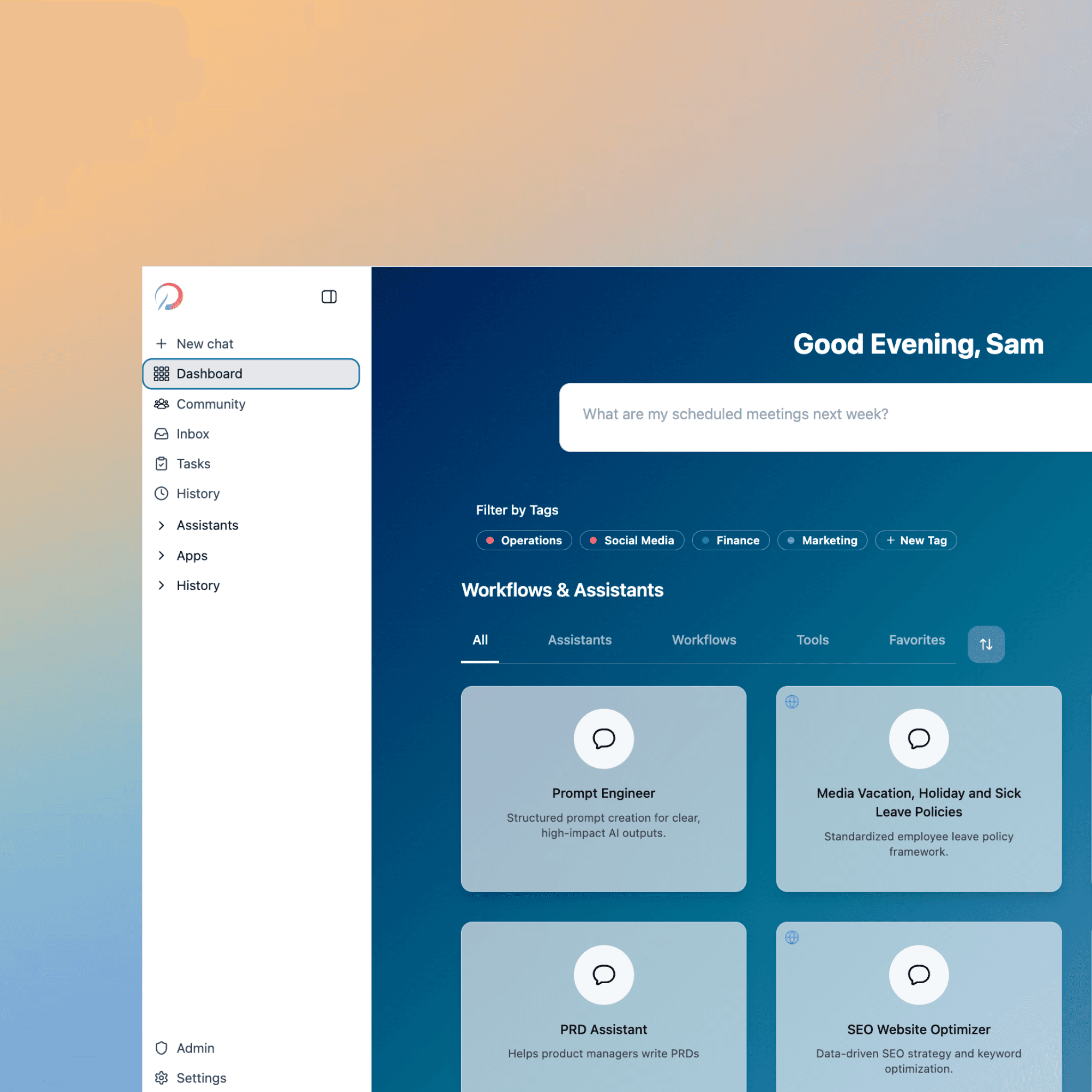
PANTA OS is built for exactly this phase. An environment where AI is not only explored but reliably used in daily work.
The pilot phase is over.
PANTA OS is already powering workflows for editorial teams, legal departments, operations leaders and insurances across Europe. See what it can do for yours.